|
August 2025
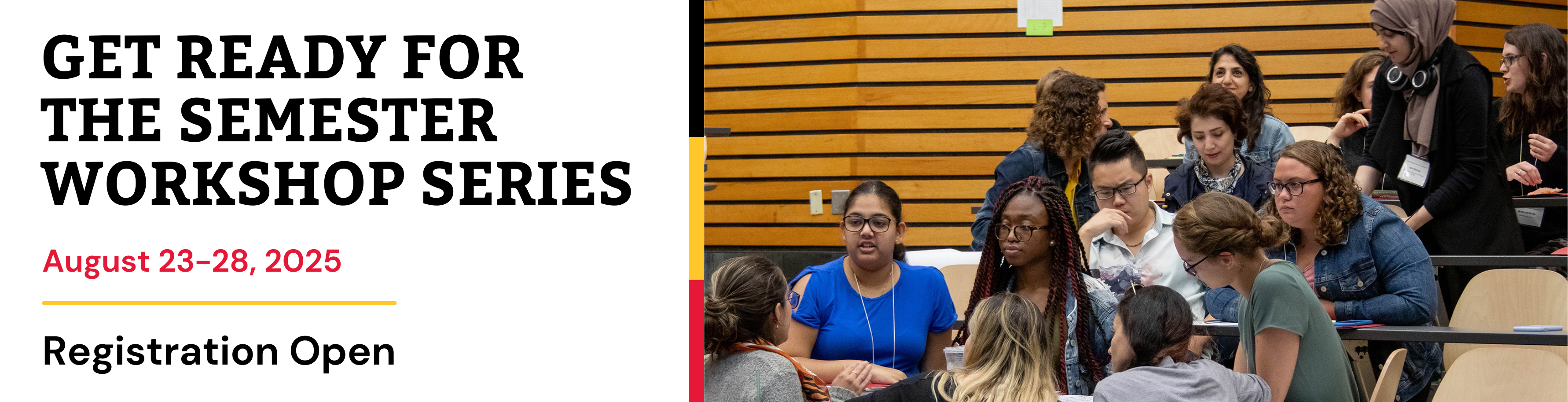
Registration Open: Get Ready for the Semester Workshop Series
Join us for the Get Ready for the Semester Workshop Series, taking place August 25-28th, 2025. This year, we are offering eight workshops:
Workshops are open to any faculty, instructors, staff, post docs, and graduate students from the University of Guelph, University of Guelph-Humber, and Ridgetown Campus.
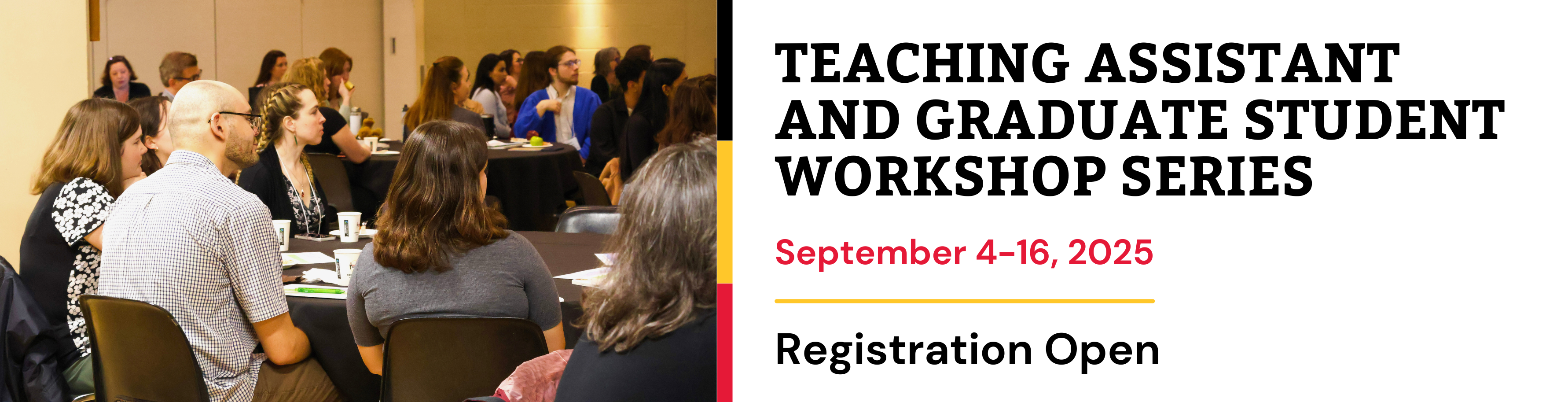
Registration Open: Teaching Assistant and Graduate Student Workshop Series
Are you a new Teaching Assistant (TA) at the University of Guelph? Are you an experienced TA looking to enhance your skills in teaching and grading? Are you a graduate student or post doc interested in engaging in teaching professional development? Join us September 4 -16th, 2025, for a series of virtual workshops to help prepare you with the teaching-related skills, knowledge, and tools you’ll need to be successful in your teaching practice.
Faculty and instructors: Please share this information with your TAs and graduate students!
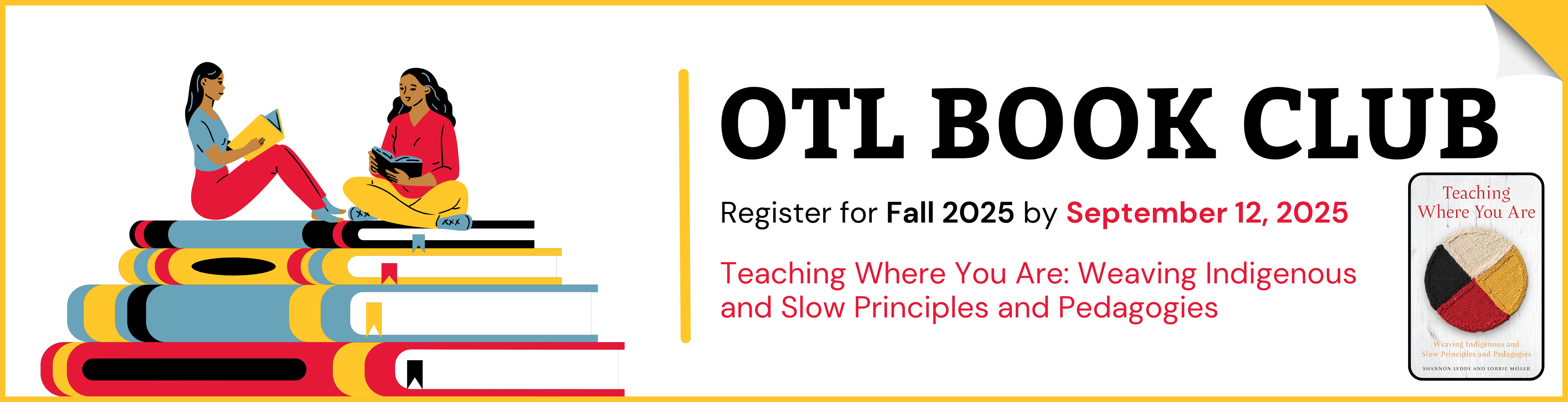
Registration Open: Fall Book Club 2025, "Teaching Where You Are"
During the Fall 2025 semester, OTL will be hosting an in-person and virtual book club to discuss and practice, “Teaching Where You Are: Weaving Indigenous and Slow Principles and Pedagogies” (Leddy & Miller, 2023). The book club is open to all University of Guelph, University of Guelph-Humber, and Ridgetown faculty, staff, instructors, teaching assistants, and graduate students. We will approach this book club through a decolonial lens of experiential and wholistic learning. At each meeting, book club members will take part in a facilitated discussion of chapters in the book and share their thoughts, questions, and experiences. We will augment these discussions with opportunities to engage in Indigenous pedagogies, offering space for decolonial, Indigenized, and reconciliatory conversation, as well as practice and guidance on how educators can apply these approaches in their own contexts. Register by September 12th. Space is limited.
Registration Open: AI in Teaching and Learning Community of Practice
Co-hosted by the Library and Office of Teaching and Learning, the AI in Teaching Community of Practice brings together educators for honest conversations about artificial intelligence in education. As AI technologies rapidly evolve, faculty face new classroom questions and opportunities, with perspectives ranging from excitement to caution. This community fosters real dialogue about teaching challenges and shared learning experiences. We welcome informed discussion among AI enthusiasts and skeptics alike. Any University of Guelph, University of Guelph-Humber, or Ridgetown educator - faculty, sessional instructors, teaching assistants, or staff - can join. Whether you're currently using AI tools, planning to explore them, or simply curious about their impact on students and teaching, you're welcome. No plan or position required, just genuine interest. The AI in Teaching CoP begins on September 24th. Register today!
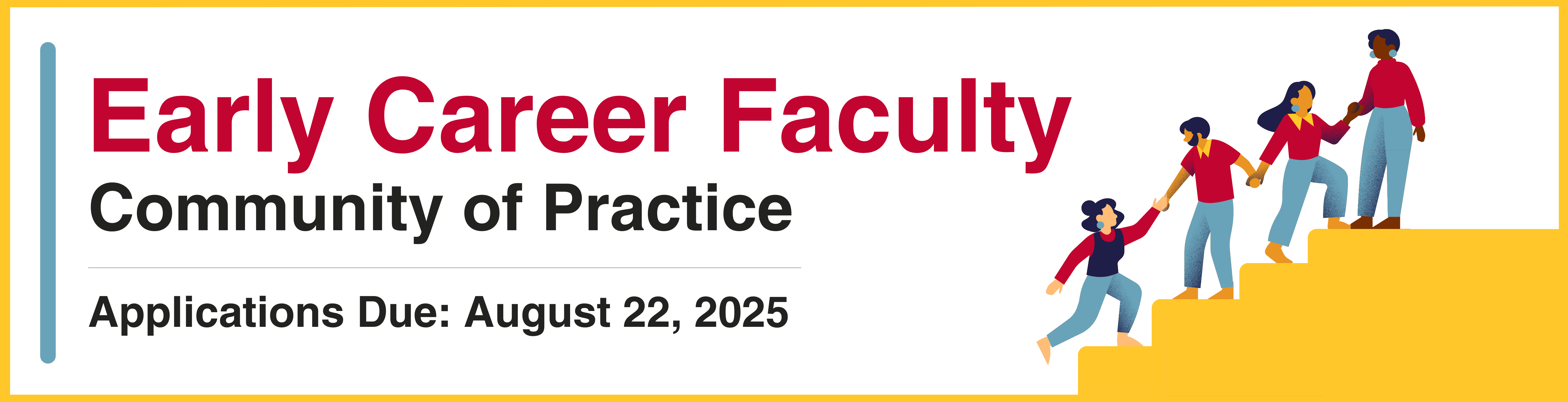
Application Reminder: Early Career Faculty Community of Practice
The Early Career Faculty (ECF) Community of Practice (CoP) is a transformative program designed to support early career faculty in their professional development as educators and leaders. Through this cross-disciplinary, relationship-rich experience, participants will engage in continuous learning, reflective teaching practices, and build connections across the university community. Eligibility: We invite full-time, tenure-track faculty members, college professor/college research professors, veterinarians, and teaching librarians at the University of Guelph, Guelph-Humber, or Ridgetown to apply. For questions or further information, contact Megan De Roover at deroover@uoguelph.ca or visit our ECF CoP webpage. Applications close August 22, 2025
AI Playbook for Teaching and Learning Leaders
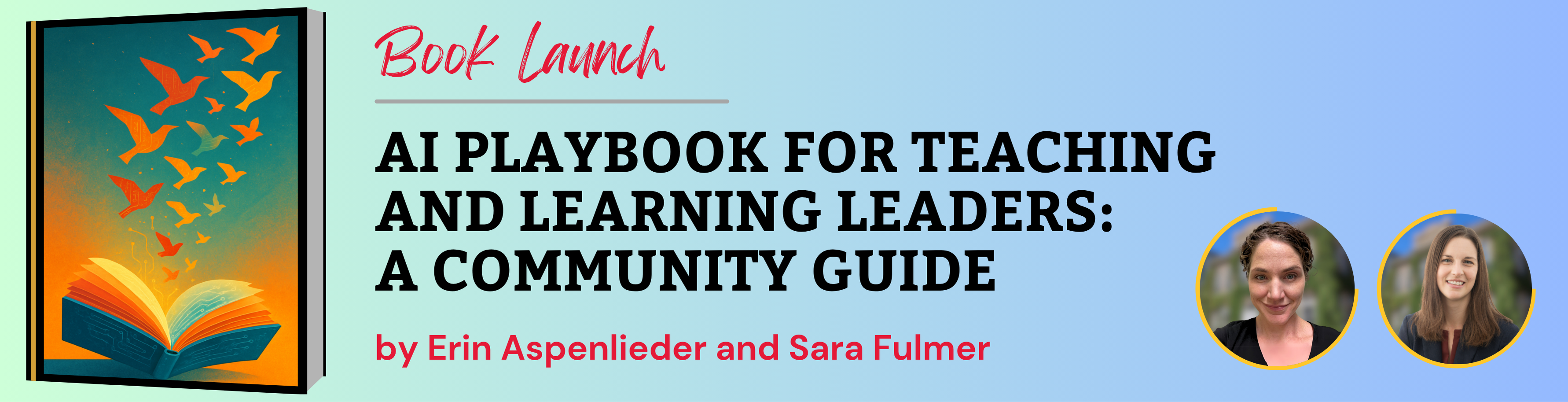
We are excited to announce the publication of a new open-access book authored by two of our OTL team members, Erin Aspenlieder and Sara Fulmer: AI Playbook for Teaching and Learning Leaders: A Community Guide This playbook offers a practical, community-informed resource for those navigating the fast-changing landscape of artificial intelligence in higher education. Rather than focusing on the “why” of AI, this guide is all about the “how,” offering actionable strategies for teaching and learning leaders ready to envision and advocate for their institution’s future. It’s designed for a broad audience, from educational developers and centre directors to faculty committees and grassroots innovators. We encourage you to explore the playbook, share it with colleagues, and consider how the ideas might apply in your own context.
Spotlight on University Teaching Leadership Fellows
The University Teaching Leadership Fellows program, launched in July 2023, supports educators in leading innovative, research-informed projects that improve student learning and success while fostering a culture of educational leadership, advocacy, collaboration, and mentorship at UofG. Last month, and again this month, we’re featuring the work and experiences of our current Fellows. In this issue, meet three more of these leaders and learn how their projects are shaping classrooms, departments, Colleges, and other units across campus. Delivered by OTL in collaboration with the Office of the Provost and Vice-President (Academic), this program is helping to drive institutional change in teaching and learning. Dr. Ryan Clemmer
College of Engineering University Teaching Leadership Fellow in Problem Analysis & Design Project: Building problem analysis skills through design Dr. Ryan Clemmer’s project enhances students’ ability to define and frame complex, open-ended problems within the engineering design curriculum. By creating and assessing teaching activities that scaffold problem analysis skills, this work supports critical and creative thinking, which is a key UofG learning outcome, and has potential for adaptation across other disciplines. Key impacts or milestones from this past year
What’s one thing this Fellowship has made possible that wouldn’t have happened otherwise? “This Fellowship has opened the possibility of conducting meaningful SoTL research. It has connected me with exceptional colleagues to learn and grow with in addition to the funding that has allowed me to work with graduate students in a non-traditional space. I have gained so much from this experience.” Dr. Shoshanah Jacobs
College of Biological Science, Integrative Biology University Teaching Leadership Fellow in Contextual Education Project: Models of Contextual Education Dr. Shoshanah Jacobs has established a partnership with the community of Iqaluktuuttiaq, Nunavut to pilot a contextual learning model that centers Indigenous knowledge, access, and inclusion. This project contributes to Indigenization, equity, and institutional change through curriculum development, community-engaged research, and policy recommendations. Key impacts or milestones from this past year
What’s one thing this Fellowship has made possible that wouldn’t have happened otherwise? “The support from this Fellowship, including the people and funding, has allowed our work to include graduate student training. This is how we create a legacy of teaching excellence.” Melanie Parlette-Stewart
McLaughlin Library, Learning and Curriculum Support University Teaching Leadership Fellow in Academic Integrity Project: Providing academic support through micro-credentials: A test case using academic integrity micro-credential Melanie Parlette-Stewart is leading the development of a micro-credential focused on academic integrity for undergraduate students. Her project enhances academic skills and student engagement while laying the foundation for a broader framework of micro-learning opportunities from the library that supports student success and retention. [Note: Melanie was on parental leave in 2023-24 and has completed the first year of her Fellowship] Key impacts or milestones from this past year
What has being a University Teaching Leadership Fellow meant to you, in your growth, your work, or your impact? “It’s been an energizing and rewarding experience to be a University Teaching Leadership Fellow and it has allowed me to focus more intentionally on how we can better support student learning. One of the most meaningful parts of the fellowship has been the opportunity to connect with such a passionate and supportive community of colleagues who care deeply, not just about teaching itself, but about the whole student. This community has reminded me why I love teaching in the first place.” Interested in connecting with one of the Teaching Leadership Fellows to learn more about them or their work? Please feel free to reach out to them directly, or connect with the Fellows program facilitator, Christie Stewart cstew@uoguelph.ca
For more teaching resources or to chat with us, Click here to unsubscribe | Follow us on LinkedIn
|
|||||||||||||||||||||||||||||||||||||||||||